
Grant application, declined
Membrane-Divided Electrowinning of Aluminum from an Aqueous Chloride Feed at Near-Ambient Temperature
NSF SBIR Phase I proposal, Chemical Technologies topic. Submitted July 27, 2026. Declined November 3, 2026, with a panel rating of Non Competitive.
The technical proposal, published in full
This is the technical content of the proposal as submitted to the U.S. National Science Foundation: the project summary, the project description with both figures and the milestone table, and the references.
Included here
- Project summary: overview, intellectual merit and broader impacts
- Project description, including the cell schematic and the milestone gates
- References cited
- A downloadable PDF of the same text
Left out or changed
- Budget, budget justification and biographical sketch
- Current and pending support
- Letters of support and consultant commitment letters
- Consultant names and company financial details
- One commercial membrane brand name, replaced with a generic description
A few sentences outside the technical plan were shortened.
The open question
The aluminum cell concept is published openly so it stays free for anyone to use and build on. The question the Phase I plan was written to answer is still open: how much water crosses the membrane with each aluminum ion, and whether that can be held low enough for aluminum to plate. If you can measure it, we would like to see the number.
info@rowow.netFrom pitch to decision
- Project Pitch submittedChemical Technologies topic.
- Invited to submit a full proposalNSF accepted the pitch.
- Full Phase I proposal submittedThe text published on this page.
- DeclinedPanel rating of Non Competitive, with six individual reviews.
- Letter to NSFTwo questions asked in writing.
- NSF repliesThe program director answered the same day.
Follow-up with NSF
NSF’s decline notice arrived on the evening of November 3, 2026. After the decline, I wrote to the NSF program director on November 4, 2026, and asked two questions in writing. NSF replied the same day. The notice and both messages are below in full. Consultant and staff names are withheld, as in the rest of this page.
What NSF’s reply confirms
- All reviewers had the full proposal, including the consultant commitment letters and the budget justification. One reviewer wrote that these “were not included in the attachment and could not be assessed.” NSF says other reviewers would overrule an objection like that and that it did not enter the panel summary.
- Preliminary data is not a requirement for Phase I. NSF says the reviewers felt the cited references did not show how the work would overcome its critical technical challenges, and that data indicating it could would have helped.
- Consultants were not weighed the same as dedicated team members. NSF says that distinction matters for a high-risk project.
What the reply does not address
- How a program whose guidance says “Feasibility must be unproven at the start of the project” reconciles that with a decline asking for data that the technical challenges can be overcome.
- Which position the panel took on whether aluminum can plate from the urea and aluminum chloride liquid, where one reviewer said it is not possible and another accepted that it plates.
- Whether publishing the membrane design openly should count against a project under NSF’s Broader Impacts criterion.
The notice and both letters
Reproduced in full. Select a message to open it.
NSFNSF’s decline notice, November 3, 2026Decline notice from the Small Businesses Section, sent by email
Reproduced as received by email on the evening of November 3, 2026, including its wording. Staff names and contact details are withheld. The reviews and panel summary it refers to were released through Research.gov.
Subject: NSF Proposal Notification, Proposal No. 2638268
Proposal Number: 2638268
Title: SBIR Phase I: Membrane-Divided Electrowinning of Aluminum from an Aqueous Chloride Feed at Near-Ambient Temperature
Dear Dr. karas,
I regret to inform you that the National Science Foundation is unable to support your proposal referenced above.
Your proposal was reviewed in accordance with the general merit review criteria established by the National Science Board that address the intellectual merit of the proposed activity and its broader impacts. These criteria permit an evaluation of the proposal’s technical merit, creativity, educational impact and its potential benefits to society. If your proposal was submitted in response to a specific solicitation, additional review criteria may have been used to review your proposal as described in the solicitation.
The full text of the two merit review criteria and supporting explanations is available in Chapter III.A of the NSF Proposal & Award Policies & Procedures Guide.
You may access the reviews of your proposal, a description of the context in which your proposal was reviewed, and any further analysis or statements at the Research.gov URL referenced below. This information may be helpful to you in understanding the Foundation’s action and also in preparing any future submissions. If you have significant concerns regarding the review process, contact the cognizant program officer whose name, email address, and telephone number are provided below.
Sincerely,
[Section Lead]
Small Businesses Section (SSB)
Directorate for Technology, Innovation and Partnerships (TIP)
Cognizant Program Officer: [Program Director, contact details withheld]
Reviews, and if applicable, the Panel Summary, Program Officer Comment, Process Statement, and Site Visit Report may be found at https://www.research.gov/.
You will need your Research.gov password to access this website. If you do not have or cannot remember your password, please go to https://www.research.gov/ for instructions on resetting or obtaining passwords.
1 Please note that certain proposals submitted to NSF are not eligible for reconsideration. Consult the NSF Proposal & Award Policies & Procedures Guide section referenced above for additional information.
RowowMy letter to NSF, November 4, 2026Two questions, asked in writing to the program director
Subject: Proposal 2638268: contradictions between the review and NSF’s stated program criteria
Dr. [Program Director],
I have read the panel summary and all six reviews for Proposal 2638268. I am not asking for reconsideration. I am writing because the review applied standards that contradict what NSF told me to submit, and I want that on record.
1. Risk was treated as a defect. NSF’s Project Pitch guidance says “Feasibility must be unproven at the start of the project.” The Seed Fund basics page asks whether there will be a substantial risk of technical failure even for an expert team. Your guidance on our June call was to propose something technically challenging, grounded in science, and difficult but not impossible. I did exactly that. Reviewer 2 then closed by calling the project “very high risk and unproven” as a reason against it.
2. Preliminary data was demanded. The panel summary opens with “no preliminary data is provided,” and Reviewer 6 says the same. NSF 26-510 does not require preliminary data for Phase I, and NSF describes Phase I as the proof-of-concept stage. A proposal cannot be required to be unproven and also penalized for not having proven it.
3. The reviewers disagree on whether the chemistry is even possible. Reviewer 2 states that aluminum deposition from AlCl3-urea with water present is “thermodynamically shown not possible.” Reviewer 5 accepts that aluminum plates from the DES and calls the proposal “a well-structured feasibility study.” Reviewer 4 calls it “potentially transformative.” The panel summary did not resolve which of these positions it adopted.
4. The team assessment ignores the consultants. The panel concluded the PI lacks the electrochemistry expertise for the work. The proposal named three consultants with directly relevant expertise, [Consultant 1] (university researcher, ion and water transport in membranes), [Consultant 2] (university researcher, ion exchange membranes), and [Consultant 3] (zinc and electrowinning metallurgy), and signed commitment letters from all three were included in the submission. Reviewer 3 acknowledged the consultants. Reviewer 1 states the consultant letters and detailed budget “were not included in the attachment and could not be assessed.” Either those documents did not reach some reviewers, or they were not read. Please tell me which.
5. Open source was counted against the project. Reviewer 5 wrote that publishing the membrane design open source “may weaken the company’s competitive position.” NSF’s own Broader Impacts criterion asks for public benefit and STEM engagement, which the open release provides directly.
The core technical question the reviewers raised, how much water crosses the membrane with each aluminum ion, is the exact measurement the Phase I plan was built to make. That question has never been answered in the literature, which is the reason it fits a program that funds unproven, high-risk R&D.
I would like a written answer on two points: whether the consultant letters and budget justification were visible to all reviewers, and how NSF reconciles its “feasibility must be unproven” guidance with a decline grounded in the absence of preliminary data.
Robert Karas
Rowow LLC
NSFNSF’s reply, November 4, 2026The program director’s answer, received the same day
Reproduced as received, including its wording errors. The program director’s name is withheld.
Dear Mr. Karas,
Individual reviews are input to the panel review process – many things get ironed out during the discussion. Panel summary is developed after a thorough discussion, where different perspectives are debated to arrive at a consensus. We also point out to reviewers where their understanding is not in alignment with our merit review criteria.
To answer your questions:
- Your full proposal with consultant letters and budget justification was visible to all reviewers. If a reviewer did not see it for any reason, they may note it, but other reviewers would overrule such objections and that fact does not make into the panel summary.
- Preliminary data are not a requirement, but reviewers felt that references did not give them required information to assess how the proposed R&D would overcome critical technical challenges. The proposal did not Providing some preliminary data that are indicative of potential to overcome those challenges would have helped them evaluate the proposal more positively.
- Consultants add to the team’s capabilities, but their involvement is different from having dedicated team members. For a high-risk project, those distinctions matter.
I hope this clarifications are helpful.
Regards,
[Program Director]
Proposal text
Project Summary
Overview
Rowow LLC will develop a membrane-divided electrochemical cell that produces aluminum from an aqueous chloride feed at near-ambient temperature, without the consumable carbon anode or the 960 degree C molten-salt bath that define the incumbent Hall-Heroult process. In the proposed cell, a low-cost ion-exchange membrane transports aluminum from an aqueous chloride anolyte into a water-tolerant aluminum-chloride-urea deep eutectic solvent (DES) catholyte, where aluminum plates at 25 to 60 degrees C, while the aqueous anode regenerates hydrochloric acid and chlorine that can drive upstream leaching. The enabling component is a homogeneous ion-exchange membrane that Rowow produces for under one dollar per square foot, against roughly fifty to several hundred dollars per square foot for incumbent perfluorinated membranes. Because the cell operates at low current density and therefore needs a large membrane area, membrane cost is decisive, and only a low-cost membrane makes the architecture economically credible. Phase I will determine the single unknown that decides feasibility: whether the membrane can deliver aluminum into the catholyte while passing little enough water that aluminum metal still plates.
Intellectual Merit
This Small Business Innovation Research (SBIR) Phase I project will resolve a fundamental and previously unanswered question in aqueous-fed metal electrowinning: how much water is co-transported with aluminum across an ion-exchange membrane from an aqueous solution into a deep eutectic solvent, and whether that water flux can be held below the threshold at which aluminum plating fails. Plating aluminum directly from water is thermodynamically excluded, and aluminum plating from deep eutectic solvents is established but commercially blocked by moisture sensitivity and cost. No prior work has integrated the two by using a membrane to feed aluminum from an aqueous source into a DES catholyte, and a literature and patent search confirms the integrated cell is absent from the record. The project is high technical risk yet grounded entirely in demonstrated physics and chemistry, since every individual element has been shown to work and only the integration and the water-transport number are unproven. The result will be either a measured, modelable basis for a near-ambient, carbon-free aluminum process or a definitive, data-backed determination of why it cannot reach commercial readiness.
Broader Impacts
Aluminum is a federally designated critical material for which the United States is roughly sixty percent import-reliant for metal and more than seventy-five percent import-reliant for bauxite, supplied domestically by only about six surviving smelters. Aluminum production is also among the most carbon-intensive industrial activities, near two percent of global emissions. A domestic, lower-carbon route that runs on low-grade and secondary feedstocks would advance United States economic competitiveness, supply-chain security, and decarbonization at once. Rowow develops its core membrane platform as open-source hardware, which supports STEM workforce development, public engagement with science, and independent reproduction. Success would also open a broader platform, since the same membrane-divided architecture extends in principle to other reactive metals. Commercially, the project targets the high-purity alumina market, valued at roughly 2.5 to 4.6 billion dollars and growing above fifteen percent annually, through modular production units with the low-cost membrane as a recurring consumable; the Phase I parallel task yields the direct precursor to this first product, so the commercial entry does not depend solely on the higher-risk metal result.
Project Description
Intellectual Merits
1.1 The problem and the opportunity
Primary aluminum is produced almost entirely by the Hall-Heroult process, which dissolves alumina in a cryolite bath at about 960 degrees C and reduces it at consumable carbon anodes. The process consumes roughly 13 to 15 kWh per kilogram of aluminum against a carbon-anode-assisted thermodynamic minimum near 6.2 kWh per kilogram (the carbon-free minimum, the fair comparator for any inert-anode route including this one, is near 9 kWh per kilogram), and it emits on the order of 14 tonnes of carbon dioxide equivalent per tonne of aluminum from three structural sources: carbon dioxide from consuming the carbon anode, perfluorocarbons released during anode effects, and the energy required to hold the high-temperature bath (IAI 2024). The process is also capital-intensive and inflexible, requiring gigawatt-scale, continuously powered facilities that cannot be turned down without damage, which forces centralization and ties new capacity to scarce low-cost baseload power.
The consequences for the United States are documented by the federal government’s own assessments. Aluminum is a federally designated critical material on both the USGS critical minerals list and the DOE critical materials list (Federal Register 2025a; DOE 2023). The United States is roughly sixty percent net import-reliant for aluminum metal, more than seventy-five percent import-reliant for bauxite, and seventy-one percent import-reliant for alumina, with about six operating primary smelters and a single operating alumina refinery remaining (USGS 2026a; USGS 2026b). Recent policy responses, including a fifty percent Section 232 tariff on aluminum imports, Defense Production Act direction to expand domestic processing and smelting, and a Department of Energy award of up to 500 million dollars toward the first new domestic smelter in roughly forty-five years, confirm that reshoring aluminum production is a recognized national priority (Federal Register 2025b; CRS 2025; USGS 2025). These interventions, however, extend the incumbent smelter model rather than changing its economics or its feedstock dependence.
This import dependence is not geological scarcity. Aluminum is the third most abundant element in the Earth’s crust, roughly eight percent by mass, held in common clays, kaolin, coal ash, and aluminous industrial residues found across the United States. The scarcity is imposed by the incumbent process chain: Bayer refining is economical only on high-grade bauxite, so every abundant domestic feedstock that is not bauxite is excluded before smelting is even considered. A process that reduces aluminum near room temperature, in modular hardware, from chloride solutions leachable from these ordinary materials would address the cost, carbon, and supply-chain problems together, and would convert a process-imposed scarcity back into the geological abundance it conceals. The opportunity is therefore large and strategically aligned with recognized national needs, and the technical question is whether such a process can be made to work.
1.2 Why this is hard, and why prior approaches fail
Two facts bound the problem, and they explain why a direct aqueous route does not exist.
First, aluminum cannot be plated from water. The aluminum reduction potential lies about 1.66 V below the standard hydrogen electrode, more than one volt below where water itself is reduced, so an aqueous aluminum bath evolves hydrogen rather than depositing metal. This is not a kinetic obstacle that a better cathode can overcome. Independent groups have confirmed across the recent aqueous-aluminum-battery literature that the cathodic current in such systems is hydrogen evolution, not aluminum deposition, including water-in-salt electrolytes, hydrate melts, and artificial interphase strategies (Pastel et al. 2022; Dong et al. 2021; Yu et al. 2025). Reported aqueous aluminum deposits, when examined, are alloys or artifacts rather than metallic aluminum. The field itself has rebranded its mechanism as alloy growth.
Second, aluminum does plate cleanly from non-aqueous media. Chloroaluminate ionic liquids and the cheaper aluminum-chloride-urea deep eutectic solvent deposit aluminum at room to moderate temperature with current efficiencies near ninety percent, and the urea-based system does so without rigorous inert-atmosphere control (Cvetkovic et al. 2020). The constraint that matters is water: single-point literature reports place the tolerance of confirmed aluminum plating in these media at roughly 0.1 to 0.5 weight percent water before aluminum-oxychloride and acid side reactions degrade the chemistry, and the full efficiency-versus-water curve has never been published. Past attempts to commercialize ionic-liquid aluminum plating were defeated not by the electrochemistry but by the cost of excluding moisture and oxygen.
The proposed cell sits exactly between these two facts. It keeps the aqueous chemistry where aqueous chemistry is cheap and effective, on the feed and anode side, and confines aluminum reduction to a thin deep-eutectic-solvent catholyte film, separating the two with an ion-exchange membrane. The unsolved question is whether the membrane can pass aluminum while holding back water. Every ion that crosses a membrane drags part of its hydration shell with it by electroosmosis, and we find no published measurement of this water co-transport for an aqueous-to-DES junction. The number of water molecules transported per aluminum ion is the single quantity that decides feasibility, and it is unknown today. This is the high-risk, high-reward core of the project: difficult, specific, and answerable, without requiring any violation of physical law.
History also supplies a cautionary precedent on the process-integration side. Alcoa’s chloride smelting process demonstrated that aluminum chloride electrolysis works at industrial scale but died on the cost of producing anhydrous aluminum chloride. Orbite Aluminae proved that hydrochloric acid leaching of clay produces high-quality alumina but went bankrupt in 2017 when its high-temperature acid-recovery hardware failed. Both failures were integration failures at exactly the interfaces this project addresses: the proposed cell accepts hydrated aluminum chloride from the aqueous side, and it regenerates hydrochloric acid electrochemically at 25 to 60 degrees C, replacing the fragile pyrohydrolysis unit that killed the prior acid route.
1.3 The innovation
The innovation is an integrated, membrane-divided cell with three coupled parts. An aqueous chloride anolyte carries aluminum from a leached feed and hosts a dimensionally stable anode that evolves chlorine, which is converted back to hydrochloric acid for reuse in leaching by the standard industrial hydrogen-chlorine combustion unit, with the chlorine-free three-compartment variant described below as the alternative that avoids gas-phase chlorine entirely, closing the chemical loop. A low-cost homogeneous ion-exchange membrane, itself patent pending, separates the aqueous side from the catholyte and transports the aluminum-bearing species while resisting water crossover. An aluminum-chloride-urea DES catholyte receives aluminum and plates it as metal at 25 to 60 degrees C.
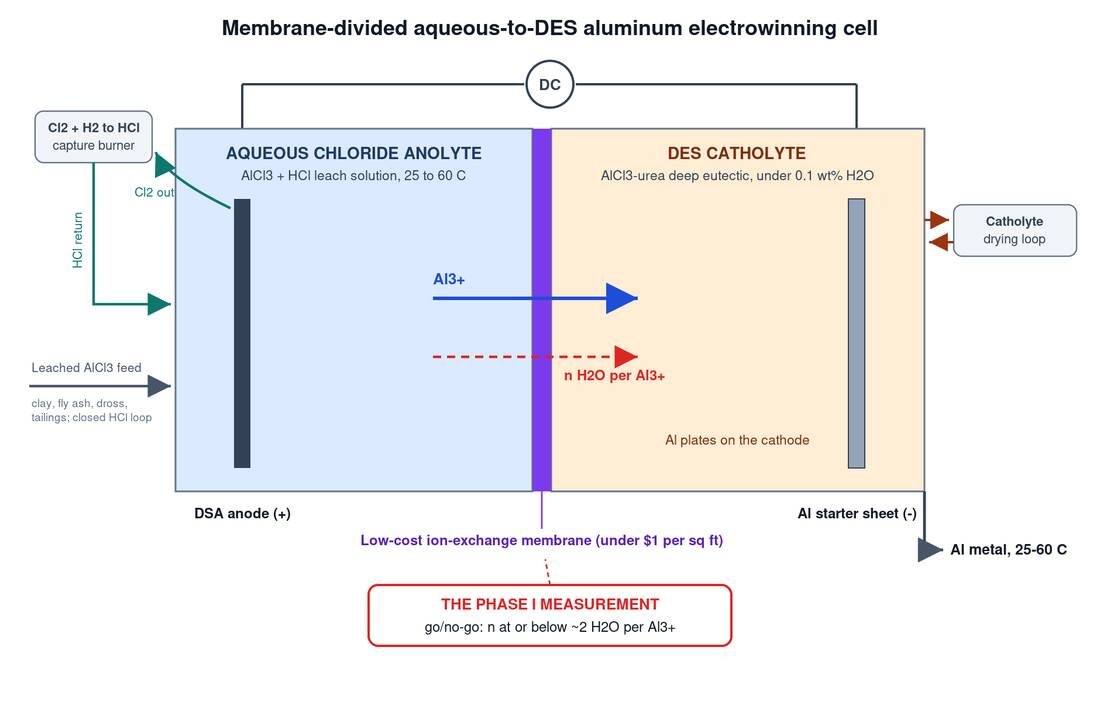
Two design variants will be evaluated. In the cation-exchange variant, the membrane passes aluminum cations directly from the aqueous feed, which is simple but maximizes the water-drag risk. In the anion-exchange variant, the catholyte is fed aluminum as chloroaluminate and the membrane passes only chloride back toward the anode, which sidesteps hydrated-cation drag at the cost of reintroducing an aluminum-chloride supply requirement. Comparing the two is part of the Phase I question.
A third configuration is held in reserve for chlorine management. In a three-compartment arrangement, a second cation-exchange membrane isolates the anode in a dilute sulfuric acid anolyte: the anode then evolves oxygen instead of chlorine, and the protons it generates migrate across that membrane into the chloride feed compartment, reconstituting hydrochloric acid directly in solution with no gas-phase chlorine to capture. This chlorine-free variant runs on the same three-compartment hardware as the parallel hydroxide task, trading a modestly higher anode potential for the complete elimination of chlorine handling, an attractive exchange at modular scale. The two-compartment chlorine-evolving cell remains the primary configuration, because chlorine-to-acid capture is standard industrial practice and retains the chlorine value, but the reserve configuration means no plausible chlorine-side failure can strand the project.
The enabling economic element is Rowow’s membrane. Because aluminum plating runs at low current density, the cell needs roughly forty to fifty times the active cell area of a smelter per unit of output, so at incumbent membrane prices of one hundred to five hundred dollars per square foot the economics collapse, while at Rowow’s sub-one-dollar-per-square-foot membrane they become credible. The membrane is a homogeneous ion-exchange film produced in-house as a family of formulations and casting thicknesses rather than a single fixed product, and that design space is itself an asset for this project: qualitative operating experience shows that thicker castings transport visibly less water while retaining serviceable conductance, while thinner castings exhibit stronger electroosmotic pumping, exactly the trade-off Task 3 quantifies. Systematic characterization of thickness, ion-exchange capacity, and area resistance across this family under aqueous-to-DES conditions is part of the proposed work, using the company’s instruments, the consultants’ measurement designs, and the external analytical facilities, with no capital equipment purchase. The sub-one-dollar figure is a measured bill-of-materials and yield result at laboratory batch scale, not a projection. The membrane is the subject of a United States non-provisional patent application with the principal investigator as inventor, and it has been operated in Rowow’s laboratory in electrodialysis and electrowinning cells. The integrated cell itself is the subject of a filed United States provisional patent application, so the architecture described here is patent pending.
1.4 Central hypothesis and Phase I objective
The central hypothesis is that an ion-exchange membrane can be configured, by resin and additive selection and by supported-liquid impregnation, to transport aluminum into a DES catholyte while limiting water co-transport to roughly one to two water molecules per aluminum ion, a level a small catholyte drying loop can manage, so that aluminum plates at a Faradaic efficiency high enough to model a competitive process.
The one-to-two-water threshold is derived, not assumed. Plating one kilogram of aluminum passes about 2,980 ampere-hours and, at a co-transport of n water molecules per aluminum ion, carries roughly 0.67 times n kilograms of water into the catholyte (about 37 moles of aluminum per kilogram, each dragging n waters). Because the aluminum-chloride-urea catholyte tolerates water only at the conservative 0.1 weight percent end of the reported range before aluminum-oxychloride and acid side reactions begin, essentially all of that influx must be removed continuously by a drying loop. At one to two waters per aluminum the influx is about 0.7 to 1.3 kilograms of water per kilogram of aluminum, a load a molecular-sieve or desiccant drying loop can hold below the tolerance at a stripping cost near 2 to 4 thermal kilowatt-hours per kilogram of water, or roughly 1.5 to 5 kilowatt-hours per kilogram of aluminum, a load the energy model carries explicitly; if total water transport reaches ten waters per aluminum, plausible for unmodified cation-exchange transport given the six-water primary hydration shell plus electroosmotic and osmotic contributions, the influx exceeds six kilograms per kilogram, which overwhelms any practical loop and consumes catholyte. The supporting techno-economic analysis anchors competitiveness: the reversible potential of the overall chloride reaction, aqueous aluminum chloride to aluminum metal and chlorine, is near 3.0 volts, so the cell will operate near 3.3 volts, with the least certain loss being ohmic drop in the modestly conductive DES film, which the thin protected-film geometry exists to bound and which Task 4 reports as a measured polarization budget; the route does not compete with smelting on energy alone. Its economic case rests on capital intensity, feedstock flexibility, ambient operation, and structural elimination of carbon-anode and perfluorocarbon emissions, and it requires roughly seventy percent Faradaic efficiency or better to keep total energy in the range of the incumbent while delivering those advantages. Because achievable efficiency is set by how much water reaches the catholyte, the water-transport number is the decisive economic as well as technical variable.
The Phase I objective is to measure, for the first time, the water-per-aluminum transport number at an aqueous-to-DES membrane junction and the resulting integrated-cell Faradaic efficiency, and to use those measurements to determine whether the architecture can support a Phase II pilot. The success criterion is quantitative and the outcome is decisive in either direction.
1.5 Research plan
The plan is four sequential tasks with explicit go/no-go gates, plus one bounded parallel task that guarantees a useful result and seeds the commercialization path. All tasks fit a twelve-month schedule and a budget that purchases no capital equipment; cells and stack hardware are fabricated in-house on the company’s CNC and other manufacturing equipment.
Task 1. Baseline kill-test and credibility anchor (months 1 to 2). Run cyclic voltammetry and 24-hour bulk electrolysis of aqueous aluminum chloride on several high-overpotential cathodes, and assay the cathode for aluminum by inductively coupled plasma mass spectrometry. The expected result is hydrogen evolution with near-zero aluminum, which establishes the design rationale on Rowow’s own data. Success metric: a measured Faradaic efficiency for aluminum at or near zero, with quantified hydrogen. Risk is low; the value is a defensible experimental foundation for every later claim.
Task 2. Water-tolerance curve of the DES catholyte (months 1 to 4). Plate aluminum from aluminum-chloride-urea at 25, 40, and 60 degrees C while titrating water content from 0.05 to 2 weight percent, measuring Faradaic efficiency and deposit quality by X-ray diffraction. This produces the curve that sets the maximum water flux the membrane may pass. Success metric: a quantified relationship between catholyte water content and plating efficiency, which the literature has not published. Mitigation for variability: controlled water dosing and Karl Fischer verification of catholyte water at each point.
Task 3. Membrane transport at the aqueous-to-DES junction, the decisive experiment (months 3 to 7). In an H-cell with 2 M aqueous aluminum chloride on one side, a Rowow membrane in the middle, and aluminum-chloride-urea DES on the other, measure aluminum flux, water transport by Karl Fischer titration with and without applied current, chloride and acid crossover, and membrane resistance over time. Karl Fischer readings in the chloroaluminate-bearing catholyte will be validated against gravimetric water spikes and oven-transfer headspace titration to control for known chloroaluminate interference with Karl Fischer reagents. Test the cation-exchange and anion-exchange variants and the supported-liquid configuration. Success metric and go/no-go gate: a water transport number n, defined as total water flux, electroosmotic plus osmotic, per aluminum flux at a stated operating point of 20 milliamperes per square centimeter and 40 degrees C from the 2 M feed, at or below 2.0 waters per aluminum ion passes; n between 2 and 6 triggers the mitigation ladder below before a decision; n above 6 with mitigations exhausted is a documented no-go. The middle band does not pass; it defines where mitigation is attempted, because the energy model shows sustained n much above 3 cannot meet the Task 4 energy gate. Mitigations include casting thickness as a primary design variable, since thicker films have shown lower water transport in qualitative service while thinner films show stronger electroosmotic pumping, resin and additive tuning, supported-liquid impregnation of the membrane with the eutectic or an ionic liquid, the anion-exchange chloroaluminate variant, and active catholyte drying. The cation-exchange variant is the primary path for its process simplicity; the anion-exchange variant is the hedge, but it reintroduces the anhydrous-aluminum-chloride supply problem that ended the Alcoa chloride process, so it is pursued only if cation-side water drag proves unmanageable. The design and interpretation of these transport measurements is the specific scope of the project’s two membrane-transport consultants, described in Company/Team.
Task 4. Integrated bench cell at 100-plus hours (months 6 to 11). Hardware fabrication begins at month 6; wetted, integrated operation begins only after the Task 3 gate is passed. Operate an aqueous hydrochloric acid or sodium chloride anolyte with a dimensionally stable anode, with chlorine captured back to acid, separated by the membrane from the DES catholyte plating aluminum onto a starter sheet. Track Faradaic efficiency, energy per kilogram including the drying-loop load, deposit morphology and dendrite behavior, and conduct a membrane post-mortem. Success metric: at least seventy percent integrated Faradaic efficiency for aluminum, total energy consumption below about fifteen kilowatt-hours per kilogram at an operating voltage near 3.3 volts with measured polarization data supporting a modeled path to twelve or below, no cell shorting across the 100-hour run, and X-ray-diffraction confirmation of metallic aluminum rather than an alloy or oxychloride in the deposit. These gate numbers close arithmetically: at 3.3 volts and seventy percent Faradaic efficiency, electrolysis consumes about 14.0 kilowatt-hours per kilogram, and at n at or below 2 the drying load adds roughly one more, so the energy gate and the Task 3 water gate are the same gate seen from two sides; the modeled path to twelve requires the mitigation outcomes jointly, Faradaic efficiency near eighty-five percent, about 11.6 kilowatt-hours per kilogram of electrolysis, with n near one. Mitigations: keep the membrane off the chlorine side or use an oxygen-evolving anode, since anode chlorine and hot acid are known to degrade membranes.
Parallel Task 5. Membrane durability in aluminum service, yielding a high-purity-alumina precursor (bounded parallel effort, months 2 to 10). The intellectual-merit case for this project rests on Tasks 2 to 4. Task 5 is a smaller, parallel de-risking activity that fills a genuine and separate literature gap, since no long-duration ion-exchange-membrane durability dataset exists for one-to-three-molar aluminum chloride electrolysis. It runs the membrane in a three-chamber configuration that recovers aluminum hydroxide, a high-purity-alumina precursor, while regenerating acid, an architecture already demonstrated on related feeds, so the membrane is stress-tested in aluminum service regardless of the metal-plating outcome and the run yields a usable, commercially relevant product. Success metric: a quantified membrane degradation rate over the run, aluminum hydroxide recovery at a measured energy per kilogram benchmarked against the published value, and an ICP-MS assay of the recovered hydroxide against a four-nines-precursor impurity budget for iron, sodium, and other key impurities, which ties the guaranteed deliverable directly to the high-purity-alumina product specification that the commercialization plan depends on.
Schedule, milestones, and decision gates.
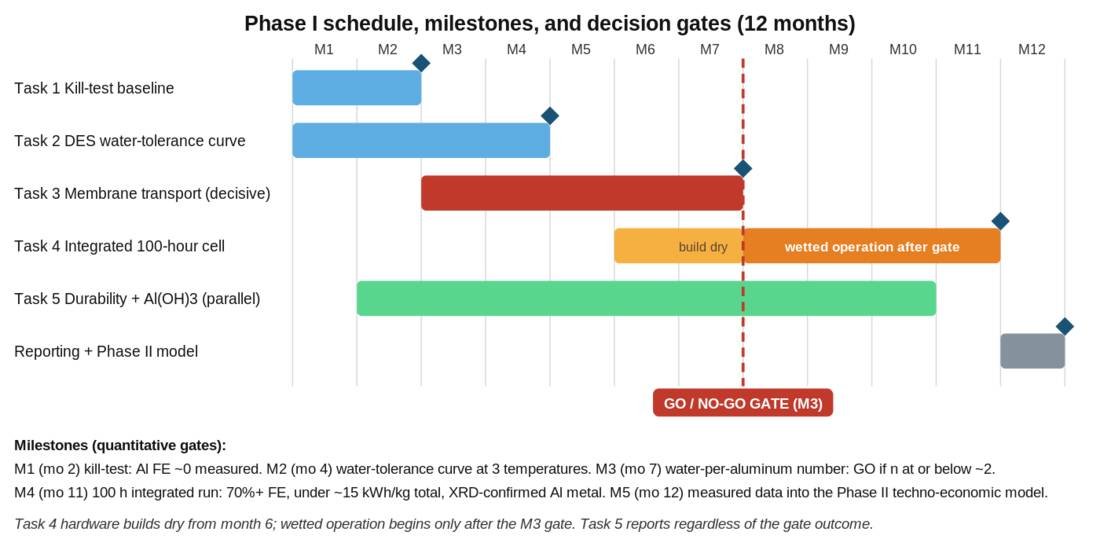
| Milestone | Month | Quantitative gate |
|---|---|---|
| M1 kill-test complete | 2 | Al Faradaic efficiency at or near zero measured on applicant hardware |
| M2 DES water-tolerance curve | 4 | Efficiency vs water content quantified at three temperatures |
| M3 decisive transport measurement | 7 | n at or below 2.0 H2O per Al3+ passes; 2 to 6 triggers the mitigation ladder; above 6, documented no-go |
| M4 integrated 100-hour run | 11 | 70 percent or better FE, under about 15 kWh per kg total with a modeled path to 12, XRD-confirmed Al metal |
| M5 Phase II model and report | 12 | Measured numbers feed the techno-economic model in either direction |
Risk and mitigation summary. The principal technical risks and their planned responses: water co-transport far above target (resin and additive tuning, supported-liquid impregnation, anion-exchange variant, drying loop, and if all fail the documented no-go plus the Task 5 result); aluminum-oxychloride fouling at the membrane’s DES face, where water carried in the hydrated membrane can hydrolyze chloroaluminate species and precipitate solids in or on the film (supported-liquid interlayer, pre-equilibration of the membrane in dried DES, periodic acid wash, and post-mortem microscopy to quantify it); membrane degradation in DES or chlorine service (post-mortem analysis, the oxygen-evolving three-compartment sulfate-anolyte option described in 1.3, membrane-off-the-chlorine-side geometry, and the Task 5 durability dataset); dendritic or powdery deposits (temperature and current-density windows from Task 2, pulse plating if needed); iron and other impurity carryover in later real-feed work (out of Phase I scope by design; Phase I uses synthetic feeds so the membrane question is answered cleanly). Sub-unity Faradaic efficiency appears as hydrogen in the catholyte head space, which the nitrogen purge and ventilation are sized to keep far below flammability limits. Moisture control is engineered, not assumed: catholyte handling will run in a nitrogen-purged glove enclosure with a desiccant train, with Karl Fischer verification at every step.
1.6 Preliminary feasibility basis
The project rests on demonstrated components rather than speculation. The membrane is Rowow’s own product, operated in the company’s laboratory in electrodialysis and electrowinning cells, and is the subject of a filed United States non-provisional patent application. Aluminum plating from aluminum-chloride-urea DES at near ninety percent Faradaic efficiency is established in the peer-reviewed literature (Cvetkovic et al. 2020). Anode-side regeneration of hydrochloric acid and chlorine from aqueous chloride is commercial practice in adjacent industries. Membrane-divided cells that transfer a single target cation between two different electrolytes through a selective membrane are demonstrated for lithium at lithium-to-magnesium selectivities near five hundred thousand to one, using a dense ceramic lithium conductor (Wang et al. 2022); the ceramic proves the divided-cell architecture but is too resistive and costly for tonnage metals, which is exactly why a low-cost polymer membrane, carrying the water-transport question this project measures, is the scalable form of the idea. Likewise, and three-chamber cells that recover aluminum hydroxide while regenerating acid are demonstrated for aluminum-bearing leachates at a published 4.88 kilowatt-hours per kilogram of hydroxide (Shi et al. 2020). The principal investigator has authored an internal feasibility assessment of the integrated route, with adversarial literature review and techno-economic analysis, which defines the experimental plan above.
No applicant measurement of the aqueous-to-DES water-transport number yet exists, because making that measurement is the central Phase I objective; the closest published analogs bound the expectation and justify the concern. Aluminum crosses a commercial perfluorinated cation-exchange membrane in Donnan dialysis with recoveries of roughly 42 to 54 percent (Kweinor Tetteh 2020), which establishes aluminum passage through practical cation-exchange membranes though not its water cost. Cations crossing a cation-exchange membrane drag water by electroosmosis, and Al3+ alone carries a six-water primary hydration shell, so an untreated membrane likely sits well above the one-to-two-water target. That is precisely why Phase I tests resin and additive tuning and supported-liquid impregnation to drive the number down, and why the measurement is decisive rather than assumed. What remains unproven, and what Phase I will establish, is the integration and the water-transport number.
1.7 Anticipated results and decision logic
By the end of Phase I the project will deliver a measured water-per-aluminum transport number, a DES water-tolerance curve, and an integrated-cell Faradaic efficiency, along with a guaranteed aluminum-hydroxide and acid-regeneration result from the parallel task. If the transport and efficiency targets are met, the data feed a Phase II techno-economic model and an integrated pilot. If they are not, the data define precisely why, and the high-purity-alumina precursor route carries the commercial path forward. Both outcomes are real results, which is the hallmark of a well-posed high-risk feasibility study.
Company/Team
Rowow LLC is a Florida small business wholly owned by Robert Karas, a US citizen, and meets all NSF SBIR eligibility requirements: fewer than 500 employees, United States operations, and all funded work performed in the United States. Founded in May 2020, the company has developed the membrane platform full time since November 2023. [Company financial details and pending-support disclosures removed from this public copy.] The five-year vision is to commercialize low-temperature, membrane-based metal production, beginning with high-purity alumina precursor and aluminum.
Robert Karas is the Principal Investigator. He invented the low-cost homogeneous ion-exchange membrane that makes the architecture affordable, the subject of a United States non-provisional patent application, and he conceived the integrated membrane-divided aluminum cell that is the subject of this project, now a filed United States provisional patent application. His inventive work extends to the surrounding cell hardware: he has separately filed a United States provisional patent application on a low-cost method of forming a durable, solderable electrical connection to graphite and carbon electrodes from commodity materials, the kind of rugged, manufacturable component the proposed cell depends on. This pattern of reducing practical electrochemical-hardware problems to filed, lab-demonstrated inventions, rather than relying on costly specialty parts, is the engineering approach the company brings to the Phase I cell.
He has worked full-time on the membrane platform since November 2023, with more than two years of daily laboratory experience formulating, casting, and testing these membranes and operating electrodialysis and electrowinning cells. The membrane has been independently reproduced by outside builders from his published documentation, and two academic authorities on membrane transport reviewed the technical plan and joined the project as paid consultants, with a forty-year industrial electrowinning practitioner completing the consulting team on the cell-engineering side. He commits ten calendar months of dedicated effort to this project, matching the proposal budget, which as the company’s full-time founder is the majority of his working year. He designed and built Rowow’s 1,400 square foot electrochemistry laboratory, which is the Phase I work site, and authored the internal feasibility assessment, with adversarial literature review and techno-economic analysis, that defines the research plan in this proposal. He also maintains Rowow’s open-source membrane platform, which has been built and reproduced by independent makers.
The Phase I team adds focused outside expertise without diluting the company’s control of the work. A university professor of chemical engineering (name withheld in this public copy) and a leading authority on water and ion transport in ion-exchange membranes, has committed in a signed consultant letter to serve as a paid technical consultant, in his individual capacity with his affiliation stated for identification only. His scope is the membrane-transport core of the project: membrane selection and configuration for transporting the aluminum-bearing species while limiting water co-transport, the design and interpretation of the water and ion transport measurements at the aqueous-to-DES junction including the water-per-aluminum transport number, assessment of permselectivity and membrane resistance behavior, and consideration of supported-liquid-membrane approaches. He commits up to four eight-hour consulting days over the Phase I period at the NSF-allowable rate; all experimental work remains with Rowow LLC. A second university professor of chemical engineering (name withheld), whose research program centers on ion and water transport in ion-exchange membranes, has likewise committed in a signed consultant letter, in his individual capacity with affiliation for identification only. The two scopes are complementary by design: the first consultant leads the design and interpretation of the Task 3 transport measurements, including the water-per-aluminum number itself, while the second consultant leads the materials response, applying fixed-charge, crosslinking, and membrane-modification strategies to drive that number down. Each commits up to four eight-hour days at the NSF-allowable rate; all experimental work remains with Rowow LLC. An industrial electrowinning consultant (name withheld) brings more than forty years of industrial nonferrous electrowinning practice, including roast-leach-electrowinning plant operation at commercial zinc producers in the United States, France, and Australia, and has committed in a signed consultant letter, in his individual capacity with affiliations for identification only. His scope is the industrial cell-engineering reality check on the integrated cell of Task 4: current efficiency and cell energy accounting, deposit quality and dendrite control, and anode, cathode, and cell hardware judgment drawn from commercial tankhouse practice. He commits up to four eight-hour days at the NSF-allowable rate; all experimental work remains with Rowow LLC. A part-time laboratory technician will execute trials, including the long-duration runs and stack assembly. Trace and confirmatory analytical chemistry will be obtained from established fee-for-service facilities: inductively coupled plasma mass spectrometry at the University of Michigan MEAL laboratory, which analyzes solutions from part-per-million to part-per-trillion levels at published external-user rates, and X-ray diffraction for deposit phase identification at the University of Central Florida Materials Characterization Facility, whose external fee schedule is in hand. Karl Fischer water titration runs in-house on a titrator acquired at project start, and routine elemental screening runs in-house on the company’s X-ray fluorescence spectrometer, reserving external analysis for trace-level and confirmatory work. This structure keeps well over two thirds of the work at the small business, consistent with SBIR requirements.
The Phase I work site is equipped beyond a typical startup bench. Rowow owns a Rigaku NEX DE energy-dispersive X-ray fluorescence spectrometer for in-house elemental assay of feedstocks, solutions, deposits, and process solids, which handles routine metal screening and reserves the external analytical subcontract for the trace-level ICP-MS, Karl Fischer, and XRD work that truly requires it. The lab also operates ceramic kilns and a 12 kilowatt induction heater for thermal and metallurgical work, a fire-assay kit for gravimetric precious-metal confirmation, a CNC router that fabricates cell, H-cell, and electrodialysis-stack hardware in-house, multiple chemical fume hoods with chlorine-rated ventilation, leak detection, and containment suited to the chlorine-evolving anode chemistry, and prototype electrolysis and electrodialysis cells. The remaining bench instrumentation the plan requires, a programmable potentiostat and laboratory-grade power supplies, a laboratory oven and analytical balance, a Karl Fischer titrator for catholyte water measurement, and a nitrogen-purged glove enclosure with a desiccant train for low-water catholyte handling, is deliberately inexpensive: each item falls below the equipment capitalization threshold, is budgeted under supplies, and will be acquired at the start of the project. The in-house CNC capability lets the team build and iterate bespoke cells at low cost rather than purchasing them, which is well matched to a Phase I budget that purchases no equipment.
Broader Impacts
The proposed technology advances several NSF-relevant national outcomes at once. Quantitative figures below are carried to the References Cited list.
Economic competitiveness and supply-chain security. Aluminum is a federally designated critical material. The United States imports roughly sixty percent of the aluminum metal it uses and more than seventy-five percent of its bauxite, and only about six primary smelters remain in operation, constrained by the need for very large, continuously powered facilities (USGS 2026a; USGS 2026b). The conventional chain is import-dependent at every stage, including alumina at seventy-one percent with a single operating domestic refinery. A near-ambient, modular process that runs on domestic low-grade and secondary feedstocks would reduce this import dependence at its most fragile upstream link and create a path to distributed domestic production that the incumbent smelter model cannot provide. Who benefits and when: processing-service customers benefit during Phases I and II; United States high-purity-alumina buyers gain a domestic option at first commercial production, targeted within two years after Phase II; domestic manufacturers and defense supply chains gain a hedge against import disruption with Phase III deployment.
Environmental impact and decarbonization. Primary aluminum production emits on the order of fourteen tonnes of carbon dioxide equivalent per tonne of metal and accounts for roughly two percent of global emissions, from three structural sources: consumption of carbon anodes, perfluorocarbon release during anode effects, and the energy required to maintain a 960 degree C bath (IAI 2024). A near-ambient, inert-anode, membrane-based route removes the carbon-anode and perfluorocarbon emissions at their source, and its near-ambient, load-flexible operation permits siting on clean or off-peak power that the incumbent’s continuous gigawatt-scale load cannot use. The proposal owns its own footprint rather than borrowing the incumbent’s: at the Phase I energy targets, route emissions are set almost entirely by the power source, roughly 4 to 6 tonnes of carbon dioxide equivalent per tonne on the current average United States grid and near zero on carbon-free power, against about 14 tonnes for the incumbent fleet, and the Phase I measured energy number will replace this estimate. Because the cell is electrically driven at low temperature, it can also load-follow intermittent renewable power, which gigawatt-scale smelters cannot do without damage.
Impact of the guaranteed Phase I deliverable. The broader impact does not depend solely on the higher-risk metal route. The parallel high-purity-alumina-precursor result is itself societally valuable: it offers a domestic, lower-impact source of high-purity alumina, a material critical to lithium-ion battery separators, LED and semiconductor substrates, and sapphire, while reusing acid in a closed loop and accepting low-grade and waste feeds.
Circular economy and distributed development. Because the process tolerates silica and accepts low-grade and secondary feeds, it opens aluminum and alumina recovery from clay, granite, coal fly ash, dross, and mine tailings. Modular, near-ambient units can be sited where the feedstock is, including at power plants, mine sites, and rural locations, supporting regional economic development and converting disposal liabilities into products.
Education, workforce, and public engagement. Rowow develops its core membrane platform as open-source hardware under a dual license, with a maker community that has independently built the membranes. This open model broadens participation in advanced manufacturing and electrochemistry, supports STEM workforce development, and enables transparent, independent validation; the strongly reciprocal license also means the open baseline cannot be captured into proprietary derivatives, so openness and the company’s commercial position reinforce rather than contradict each other. Phase I findings on membrane water transport, which have no published precedent, will be disseminated through peer-reviewed publication and conference presentation, supported by the small-business fee rather than project funds. Measurable baselines and targets: the open repository currently has more than one hundred stars and documented independent membrane builds; Phase I targets at least five additional documented independent builds, one peer-reviewed manuscript submitted from the water-transport dataset, and one conference presentation.
Mitigation of unintended consequences. The chemistry uses chlorine-evolving anodes; the cell design captures chlorine back to hydrochloric acid in a closed loop, the laboratory is equipped with chlorine-rated ventilation and leak detection, and the safety envelope is part of the Phase I engineering record. Spent DES catholyte is regenerated by drying rather than discarded; end-of-life membranes are non-fluorinated and landfill-compatible; leach residues and impurity bleeds will be characterized and disposal pathways identified before any scale-up. The open-source channel deliberately excludes the integrated aluminum cell, which remains a protected commercial technology, so openness does not create an uncontrolled proliferation path for the chlorine-handling process hardware.
Platform potential. The same membrane-divided architecture is, in principle, extensible to other reactive metals whose reduction lies outside the stability window of water. Aluminum is the entry point for a broader low-temperature, electrified approach to metal production.
Commercialization Potential
Market and beachhead. The initial commercial entry is not commodity aluminum ingot, where recycled scrap is the low-energy competitor, but high-purity alumina, or HPA. Independent market firms value the global HPA market at roughly 2.5 to 4.6 billion dollars in 2024 and 2025, projected to reach ten to sixteen billion dollars by the early 2030s at compound annual growth rates of roughly sixteen to twenty-three percent (Grand View Research 2025; Global Market Insights 2025). The market is small in tonnage, on the order of 40,000 tonnes per year of strict four-nines material, and 4N alumina sells at approximately 25,000 dollars per tonne, about ten times the price of aluminum metal and sixty times smelter-grade alumina (AL Circle 2026). The tonnage and dollar figures reconcile as follows: strict 4N material alone is roughly a one billion dollar market today, while the larger analyst figures include 3N technical alumina and downstream forms; Rowow’s Phase III target of several hundred tonnes per year is on the order of one percent of 4N tonnage, and the company notes that Chinese capacity expansion has pressured 4N prices downward, which the techno-economic model treats as a sensitivity rather than an assumption. Demand is pulled by lithium-ion battery separator coatings, which consume roughly ten tonnes of HPA per gigawatt-hour of battery capacity, by LED and sapphire substrates, and by semiconductor applications, the fastest-growing and purity-hungriest segment. The binding constraint in HPA is purity, which a selective membrane and electrochemical route is built to deliver, and non-smelter HPA routes have already proven customers and attracted capital at commercial scale. A meaningful market position requires only hundreds of tonnes per year, well matched to the scale a small business can reach after Phase II. The three-chamber aluminum-hydroxide and acid-regeneration cell developed as the Phase I parallel task is the direct precursor to this product, which is why it serves as the commercial entry point.
Markets beyond the beachhead. If Phase II and Phase III scale-up delivers aluminum at competitive cost, the metal route inherits demand channels well beyond commodity ingot. Aluminum already substitutes for copper at scale where the engineering case closes, most visibly in high-voltage transmission conductors, and modular siting at the feedstock lets production land near those users. Emerging aluminum-consuming energy technologies add further pull: aluminum-air primary batteries, where the metal is the consumable, and aluminum-as-fuel concepts in defense and marine research that exploit the roughly 31 megajoules per kilogram released on full oxidation. None of these markets is part of the Phase I commercial case, and the plan does not depend on them; they describe the option a successful membrane measurement opens.
Business model and revenue path. Rowow’s model has three revenue layers that build on one another. First, near term and already active at small scale, processing services and demonstration runs for customers with aluminum-bearing and related feeds, which generate revenue and customer relationships during Phase I and II. Second, the core product: modular HPA-precursor production units sold or operated in partnership, sited at feedstock sources. Third, the recurring layer: because the membrane is engineered as a low-cost, replaceable module rather than a permanent, high-value component, every deployed unit generates ongoing membrane and consumables revenue on a roughly annual replacement cycle, a target consistent with the membrane’s observed service life in related duty and to be validated by the Task 5 durability dataset, priced as a margined consumable, so recurring revenue scales with deployed membrane area rather than with unit count alone. This consumable-membrane model lowers the barrier to adoption, since the customer is not asked to bet on a lifetime membrane, and it converts Rowow’s manufacturing cost advantage into a durable revenue stream.
Unit economics. The commercial case rests on producing HPA precursor at a cost well below the prevailing 4N price of about 25,000 dollars per tonne, with the low-cost membrane as the main consumable. The company’s techno-economic model, anchored on the published 4.88 kilowatt-hour-per-kilogram energy benchmark for three-chamber aluminum hydroxide recovery and current industrial electricity prices, projects a precursor cash cost in the range of 1,900 to 2,300 dollars per tonne of alumina equivalent at initial modular scale, roughly a tenth of the 20,000 to 25,000 dollar 4N price band, with electricity and small-scale labor as the dominant costs. Membrane replacement is held near one hundred dollars per tonne only because of the company’s membrane cost position: the identical model run at a one-hundred-dollar-per-square-foot incumbent membrane price exceeds 12,000 dollars per tonne, which is the quantitative core of the competitive advantage. These are precursor costs, not finished qualified 4N product costs; finished product additionally requires calcination and customer qualification, a cycle that typically runs a year or more and is carried in the Phase III schedule, and even doubling the precursor cash cost to cover finishing leaves a several-fold margin to the 4N price band. Further, Phase I replaces the benchmark energy number with measured data, and the I-Corps customer discovery tests the price side. The favorable starting point is that the dominant cost lever, membrane area, is exactly where Rowow has its advantage.
Competitive advantage and barriers to entry. The defensible edge is twofold. First, the cell needs roughly forty to fifty times the active cell area of a smelter because it runs at low current density, so membrane cost is decisive, and Rowow’s sub-one-dollar-per-square-foot membrane is what makes the required area affordable when incumbent perfluorinated membranes at roughly fifty to several hundred dollars per square foot would not. The open and proprietary boundaries are deliberate. The baseline membrane platform is published under a strongly reciprocal open-hardware license; that license permits commercial use, so the license is not the moat. The moat is the patent-pending integrated cell, the proprietary aluminum-service membrane variants developed in Task 3 including the supported-liquid and DES-compatible configurations, the manufacturing cost position, and the accumulated process know-how, with the share-alike terms adding one further layer by preventing a competitor from taking the open baseline proprietary. Second, the integrated membrane-divided aqueous-to-DES aluminum cell is white space: a literature and patent search found it absent, and it is now the subject of a filed United States provisional patent application. The combination of a low-cost enabling component, a filed patent position on the integrated cell, and an open-core brand forms the moat.
Intellectual property strategy. The membrane composition and manufacturing method are covered by a pending United States non-provisional application; the integrated aluminum cell is covered by a filed provisional application with the non-provisional conversion scheduled within the priority year; a further provisional covers the low-cost electrode-connection hardware. The company deliberately separates its open-source membrane-platform publications from the protected integrated-cell IP, and no public disclosure of the integrated cell preceded the provisional filing. TABA funds will support a professional IP landscape review during Phase I.
Regulatory, permitting, and safety. The Phase I work is bench-scale in an equipped private laboratory and requires no special permits; chlorine handling follows the closed capture loop and the chlorine-rated ventilation described in Facilities. At commercial scale the process is a low-temperature electrochemical plant handling hydrochloric acid and chlorine in closed loops, a well-understood industrial safety envelope regulated under standard OSHA process-safety and EPA air and water frameworks, with none of the fluoride emissions, spent-potlining hazardous waste, or perfluorocarbon permitting burdens of a smelter.
Competitive landscape and evidence the category is fundable. Incumbent HPA supply is dominated by high-cost routes based on refining aluminum metal or alkoxide precursors, held by established producers such as Sumitomo and Sasol and largely located outside the United States, while non-smelter entrants, notably Alpha HPA at commercial scale with customer offtakes and Altech Advanced Materials, have validated customer demand and capital availability for alternative HPA routes. In adjacent electrochemical metals, Electra is commercializing low-temperature aqueous iron, Magrathea is backed by a 100 million dollar defense award for electrochemical magnesium from chloride brine, and modular critical-mineral recovery companies such as Nth Cycle, with prior NSF SBIR support, have reached commercial operation. This validates both the modular-electrochemical thesis and the HPA beachhead, while none of these ventures addresses aluminum through a membrane-divided aqueous-to-DES cell, which remains open ground.
Customer validation. Customer discovery will be pursued through the NSF I-Corps program during Phase I, targeting at least one hundred interviews across HPA buyers in batteries, LEDs, sapphire, and semiconductors, and across secondary-feedstock processors; the interviews are conducted by the PI with the part-time technician maintaining laboratory continuity, and if I-Corps acceptance is not secured, the same interview program proceeds by direct outreach without the I-Corps supplement. The company is in active discussions with prospective high-purity-alumina buyers and with fly-ash and kaolin feedstock suppliers, and any letters of support received before submission will accompany the proposal.
Commercialization path. Phase I establishes core feasibility and the guaranteed HPA-precursor result. Phase II would build an integrated, continuously operated unit and validate HPA-precursor economics with a lead customer. Phase III would commercialize by selling modular units and processing services, with the low-cost membrane as a recurring consumable.
Role of NSF support. NSF funding is the catalyst that makes this work possible now. The decisive water-transport measurement has no commercial customer until it exists, and the company’s service revenue can sustain operations but not a year of dedicated high-risk research. A Phase I award converts a well-posed scientific question into either a fundable process company or a definitive public answer.
AI-use disclosure. Generative AI tools were used to assist with final drafting and editing the text of this proposal. All technical content, data, claims, and the research plan were originally drafted, conceived, verified, and approved by the Principal Investigator.
References Cited
AL Circle (2026). “High purity alumina market by 2036: supply shifts, price volatility and future growth drivers.” AL Circle News, April 28, 2026. https://www.alcircle.com/news/high-purity-alumina-market-by-2036-supply-shifts-price-volatility-and-future-growth-drivers-118239
Congressional Research Service (CRS) (2025). “Using the Defense Production Act to Increase Domestic Mineral Production.” CRS Insight IN12540. https://www.congress.gov/crs-product/IN12540
Cvetkovic, V. S., Vukicevic, N. M., Jovicevic, N., Stevanovic, J. S., and Jovicevic, J. N. (2020). “Aluminium electrodeposition under novel conditions from AlCl3-urea deep eutectic solvent at room temperature.” Transactions of Nonferrous Metals Society of China 30(3), 823-834. DOI 10.1016/S1003-6326(20)65257-8
Dong, T., Ng, K. L., Wang, Y., Voznyy, O., and Azimi, G. (2021). “Solid Electrolyte Interphase Engineering for Aqueous Aluminum Metal Batteries: A Critical Evaluation.” Advanced Energy Materials 11(20), 2100077. DOI 10.1002/aenm.202100077
Federal Register (2025a). “Final 2025 List of Critical Minerals.” U.S. Geological Survey, November 7, 2025. https://www.federalregister.gov/documents/2025/11/07/2025-19813/final-2025-list-of-critical-minerals
Federal Register (2025b). “Adjusting Imports of Aluminum and Steel Into the United States.” Presidential Proclamation, June 9, 2025. https://www.federalregister.gov/documents/2025/06/09/2025-10524/adjusting-imports-of-aluminum-and-steel-into-the-united-states
Global Market Insights (2025). “High Purity Alumina (HPA) Market.” Industry report, December 2025. https://www.gminsights.com/industry-analysis/high-purity-alumina-hpa-market
Grand View Research (2025). “High Purity Alumina Market Size, Share and Trends Analysis.” Industry report. https://www.grandviewresearch.com/industry-analysis/high-purity-alumina-market
International Aluminium Institute (IAI) (2024). Greenhouse gas emissions intensity of primary aluminium (cradle-to-gate) and primary aluminium smelting energy intensity. Statistical series. https://international-aluminium.org/statistics/greenhouse-gas-emissions-primary-aluminium/ and https://international-aluminium.org/statistics/primary-aluminium-smelting-energy-intensity/
Kweinor Tetteh, E. (2020). “Ion Exchange Dialysis for Aluminium Transport through a Face-Centred Central Composite Design Approach.” Processes 8(2), 160. DOI 10.3390/pr8020160
Pastel, G., et al. (2022). “A sobering examination of the feasibility of aqueous aluminum batteries.” Energy and Environmental Science 15. DOI 10.1039/D2EE00134A
Shi, Y., Jiang, K., Zhang, T., and Lv, G. (2020). “Cleaner alumina production from coal fly ash: Membrane electrolysis designed for sulfuric acid leachate.” Journal of Cleaner Production 243, 118470. DOI 10.1016/j.jclepro.2019.118470
U.S. Department of Energy (DOE) (2023). “Notice of Final Determination on 2023 DOE Critical Materials List.” Federal Register, August 4, 2023. https://www.federalregister.gov/documents/2023/08/04/2023-16611/notice-of-final-determination-on-2023-doe-critical-materials-list
U.S. Geological Survey (USGS) (2025). Mineral Commodity Summaries 2025: Aluminum. https://pubs.usgs.gov/periodicals/mcs2025/mcs2025-aluminum.pdf
U.S. Geological Survey (USGS) (2026a). Mineral Commodity Summaries 2026: Aluminum. https://pubs.usgs.gov/periodicals/mcs2026/mcs2026-aluminum.pdf
U.S. Geological Survey (USGS) (2026b). Mineral Commodity Summaries 2026: Bauxite and Alumina. https://pubs.usgs.gov/periodicals/mcs2026/mcs2026-bauxite-alumina.pdf
Wang, L., Arnold, S., Ren, P., Wang, Q., Jin, J., Wen, Z., and Presser, V. (2022). “Redox Flow Battery for Continuous and Energy-Effective Lithium Recovery from Aqueous Solution.” ACS Energy Letters 7(10), 3539-3544. DOI 10.1021/acsenergylett.2c01746
Yu, M., et al. (2025). “Hydrate-melt electrolyte design for aqueous aluminium-bromine batteries with enhanced energy-power merits.” Nature Communications 16. DOI 10.1038/s41467-025-61740-y